

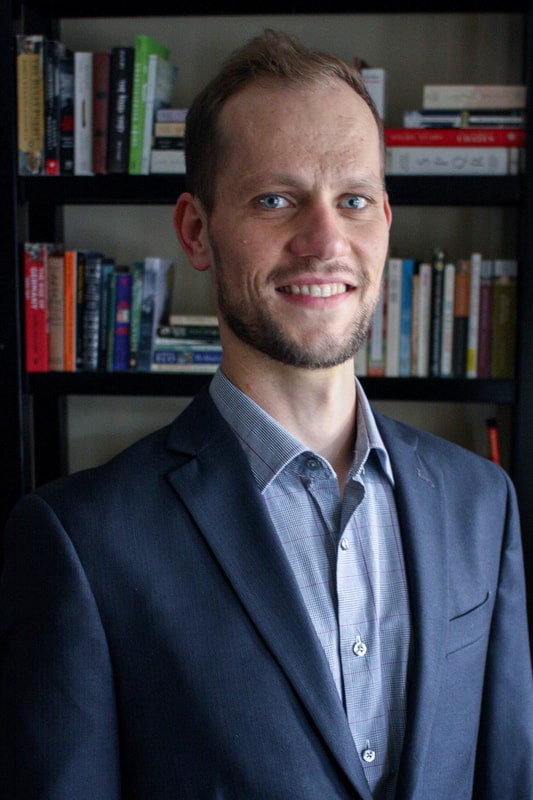
CGSP affiliate faculty member Fedor Dokshin is an Associate Professor, and Associate Graduate Chair in the Department of Sociology at the University of Toronto. His research focuses on the social and organizational dynamics of the energy transition, including how political identity, market intermediaries, and policy design shape the diffusion of new energy technologies and the distribution of their benefits. His work has been published in PNAS, Nature Energy, Nature Human Behaviour, and the American Sociological Review, and supported by grants from SSHRC and the NSF.
How did you first become interested in your area of research?
My first encounter with energy research came through fracking. I was doing my PhD at Cornell, in upstate New York, right as the shale gas revolution was taking off. The topic was everywhere—on my long bike rides, I’d pass dozens of pro- and anti-fracking yard signs, sometimes in neighbouring yards. I came at it through my sociological interests: political contention and polarization, social movements, institutional change. At first, fracking was just a case study for those things. But the more I looked, the more obvious it became that energy systems are social systems, and that sociologists really have something to offer here.
Somewhere along the way, the case study became the main event—I got hooked on energy itself. It’s this fundamental thing: you need energy to do absolutely anything, and yet it sits quietly in the background of social life. People don’t think about it, mostly don’t want to think about it, but it underpins everything we do.
What is something surprising that has emerged during your research?
A lot of my recent work looks at why people make household energy upgrades. There is a popular assumption that home energy upgrades are the result of a calculated and rational decision-making process that happens at the level of the individual homeowner. For example, when a homeowner chooses to install rooftop solar panels or replace their gas furnace with an electric heat pump, we assume that they have carefully weighed their options and have determined that renewable energy system will save them a certain amount of money.
My research shows that this assumption isn’t necessarily true. Most of us don’t like to think about our home’s energy use at all. So decisions depend much more on social context. For example, are solar panels common in my neighbourhood? When my gas furnace breaks down, does the service provider offer to replace it with a heat pump or do they only install gas furnaces?
What challenges have you encountered through your research, and what kinds of policies are required for addressing them?
Energy systems are social systems, so the energy transition is also a chance to undo some of the inequalities that were baked into the old fossil-fuel system. But it cuts both ways—there’s a real risk the transition just reproduces those inequalities, or invents new ones.
A lot of my work has simply tried to document where things actually stand, and the disparities are real: solar tends to land first, and most often, in whiter, higher-income neighbourhoods. What’s striking is that it’s not only about who gets solar—even among the households that do, we found the quality of the installations varies along income and racial lines. Some of that we trace back to biased and even predatory behaviour by installers.
On the policy side, this means widening the lens. We need consumer protections against predatory practices, far more attention to the firms and installers actually shaping the market, and recognition that local policies and community organizations can make deployment dramatically more equitable.
And there’s one more wrinkle. Because climate change demands a rapid shift to renewables, speed is its own imperative—but moving fast and being fair don’t always pull in the same direction. That tension is genuinely hard to manage.
What advice do you have for students who are interested in doing research that takes up themes that are similar to yours?
I’ve spent more than a decade publishing on energy and the environment, but I’ve always thought of myself as a sociologist first—and that’s probably the most useful advice I can offer. When you fall for a topic, the temptation is to burrow straight into it: read everything on energy, become “the energy person.” But what’s actually let me contribute isn’t just knowing the subject—it’s bringing a sociological lens to it. Good disciplinary training lets you see things that people coming at the same topic from other directions simply can’t.
So my advice is to invest in your discipline—the theory and the methods—at least as much as the topic itself. The subject expertise will need to come either way, of course. The distinctive thing you bring is the perspective.
Related Profiles
-
Fedor Dokshin
Researcher