


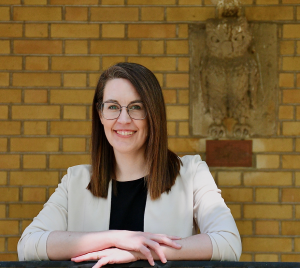
CGSP affiliate faculty member Joanna Pepin is an Assistant Professor in the Department of Sociology at the University of Toronto. Prior to this position, she was an Assistant Professor in the Department of Sociology at the University at Buffalo (SUNY) and a Postdoctoral Fellow in the Population Research Center at the University of Texas – Austin. As a family sociologist, she explores how couple and family relations reproduce and protect against inequality. Dr. Pepin’s current projects investigate what constitutes an “equal” relationship and how work and family arrangements relate to mental health.
How did you first become interested in your area of research?
As a family sociologist and demographer, I examine how couple and family relationships reflect and shape broader patterns of social inequality. My intention when starting college was to become a couple and family therapist. I carried out my first research project in a master’s program and was fascinated by the pop culture advice about relationships that was mostly at odds with what I was learning about healthy relationships. As a therapy intern, I repeatedly encountered couples who were struggling with sharing power in their relationships. Some of these challenges were mundane, even if consequential to the relationship, but some of these relationships were abusive, which required referrals to other services. After graduating, I began working in the field of intimate partner violence where I became involved in the policy efforts to pass laws guaranteeing survivors reasonable work accommodations to keep themselves safe and paid time off to seek services related to abuse. Seeking a more prevention-oriented approach, I returned to academia to explore the spectrum of power in romantic relationships. My sociological and methodological training opened new ways for me to explore the demographic and cultural changes impacting expectations about intimate relationships and how these aspirations are realized and challenged amid broader social change.
What is something surprising that has emerged during your research?
During my PhD, I replicated a study showing that gender attitudes among U.S. adults became increasingly progressive before stalling in the mid-1990s. When I extended this research to American high school seniors, I expected to find a similar pattern of continued progress. However, I found that some gender attitudes among youth not only stalled but also showed signs of reversal to more conservative beliefs. I spent a lot of time trying to figure out where I had made a coding mistake, even though it turned out to be accurate. At the time my research was published, established researchers also seemed skeptical of my findings. From the vantage point of today, given the dramatic changes in US politics, I now view my empirical evidence as an early predictor of things to come, rather than a surprise.
Less surprising to me, but considered very surprising among the public, was my co-authored research showing that married mothers spend more time on housework and less time sleeping than mothers not living with a partner. It is counterintuitive that a mother who has a partner to share the household labour would spend more time doing housework time than single mothers. We argued that these finding reflect societal views about what is expected of married mothers, and in turn, mothers’ own expectations for themselves. Still, it’s important to note that it is not the case that single mothers have it easier than married mothers, as they shoulder distinct stress and pressure. It is also important to acknowledge that fathers also confront unique societal pressures (e.g., to provide financially).
What challenges or social problems have you encountered through your research, and what kinds of policies are required for addressing them?
When it comes to bringing about gender equality, many vital policies to date have targeted the workplace and women’s engagement in it. A lot of progress has been made but the stall in the gender revolution taught us that some policies are necessary but not sufficient to bring about gender equality at work and at home. My research, along with the work of many other scholars, suggests that policies that are gender neutral are not sufficient because they do not address underlying cultural norms.
My work in the domestic violence field taught me that the way issues are framed has a great impact on how society thinks about solutions to a social problem. One reason I’m interested in understanding people’s attitudes about work-family issues is that they provide critical information about where policies can intervene to bring about a more equal society. Going forward, social policies will need to explicitly target family life and men’s contribution to sharing the load at home. My conclusion is that policies must address both structural barriers to creating equal relationships, along with beliefs about gender.
What do you wish the general public knew about your research, and what would you like them to do with this knowledge?
There isn’t a one-size-fits all approach for creating equal relationships, as there are benefits and drawbacks with every strategy. For example, I’m often asked if I think couples should keep individual banking accounts or use one joint, shared account. Individual accounts are important to having financial autonomy, but joint accounts increase access to money for the lower earning partner. So, the answer depends on the needs of the individual and the couple. What is most important in addressing at one point in time in a relationship may be different at another point in time and certainly varies between couples. That said, if there is any common thread among the most equal couples, it’s that they tend to report that they both feel like their partner is doing more than their fair share, so each partner works hard to match their partner’s contribution.
But, what I really hope people recognize is that relationship inequalities are not simply the result of individual choices. Although individuals can make changes within their own relationships, as a sociologist, I strongly believe that changes at the structural level are more substantial for more families in a most lasting way.
What advice do you have for students who are interested in doing research that takes up themes that are similar to yours?
As a scholar of time use and a follower of Oliver Burkeman’s wisdom, I would encourage students to recognize that no one can do everything, so decide what matters most to you and invest your finite time and energy accordingly. Pursue questions that you find genuinely interesting, because curiosity is often what sustains good work over the long term, while remaining open to where that curiosity may lead. I would also encourage students to be skeptical of conventional wisdom, including ideas that seem widely accepted. Many important sociological insights come from uncovering the gap between what we think we know and what the empirical evidence actually demonstrates. Finally, I think it is important to share research findings beyond academia. Communicating complex ideas to broader audiences is an important part of scholarly practice and a responsibility of researchers, helping to ensure that new knowledge contributes to public understanding and informs debates about how best to address the challenges facing society.
Related Profiles
-
Joanna Pepin
Researcher