

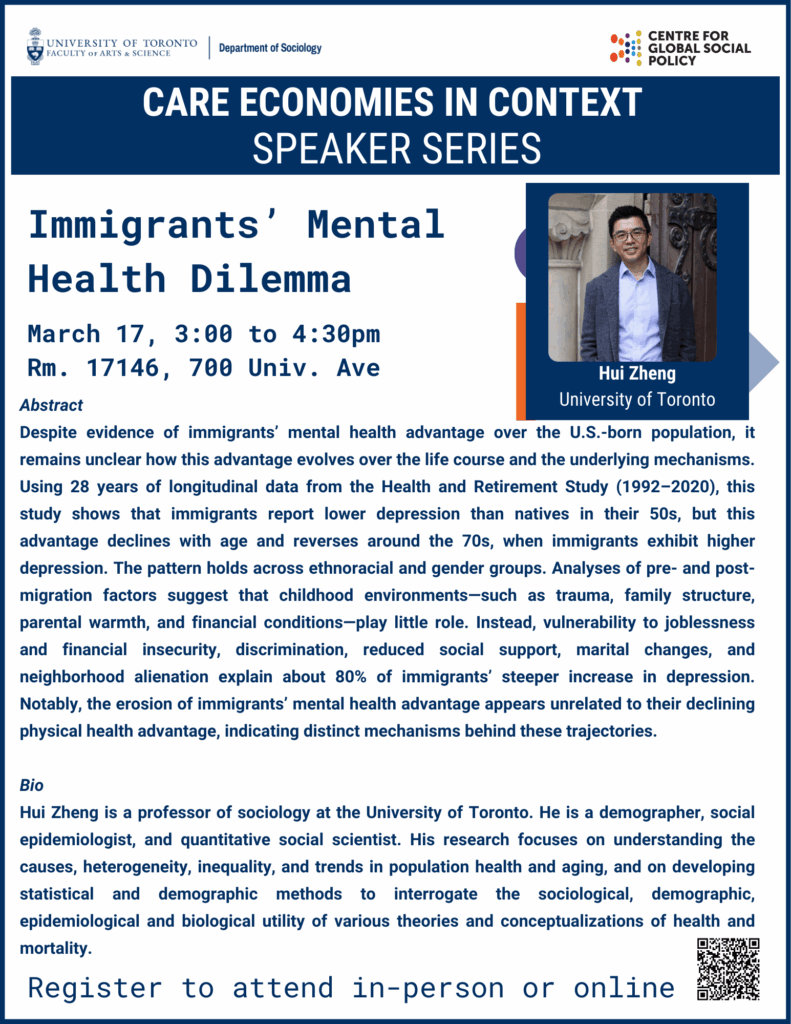
On March 17 from 3:00 – 4:30 pm ET, professor Hui Zheng will present “Immigrants’ Mental Health Dilemma.” This hybrid event is part of the Care Economies in Context Speaker Series.
Note that the in-person event will be held in Room 17146. The original version of this post had the wrong room listed.
Abstract
Despite evidence of immigrants’ mental health advantage over the U.S.-born population, it remains unclear how this advantage evolves over the life course and the underlying mechanisms. Using 28 years of longitudinal data from the Health and Retirement Study (1992–2020), this study shows that immigrants report lower depression than natives in their 50s, but this advantage declines with age and reverses around the 70s, when immigrants exhibit higher depression. The pattern holds across ethnoracial and gender groups. Analyses of pre- and post-migration factors suggest that childhood environments—such as trauma, family structure, parental warmth, and financial conditions—play little role. Instead, vulnerability to joblessness and financial insecurity, discrimination, reduced social support, marital changes, and neighborhood alienation explain about 80% of immigrants’ steeper increase in depression. Notably, the erosion of immigrants’ mental health advantage appears unrelated to their declining physical health advantage, indicating distinct mechanisms behind these trajectories.
Bio
Hui Zheng is a professor in the Department of Sociology at the University of Toronto. He is a demographer, social epidemiologist, and quantitative social scientist. His research focuses on understanding the causes, heterogeneity, inequality, and trends in population health and aging, and on developing statistical and demographic methods to interrogate the sociological, demographic, epidemiological and biological utility of various theories and conceptualizations of health and mortality. He has studied the impact of social structures and institutions—such as income inequality, medical expansion, work environment, and the marriage market—on health outcomes; trends in health disparities; heterogeneity in aging and mortality; the life course effects of obesity; and the role of selection in health production and aging. His current projects address rising health challenges in the U.S., and nativity disparities in labor market outcomes, aging, and health. His work has been supported by the U.S. CDC and NIH, published in leading journals including American Sociological Review, Demography, American Journal of Epidemiology, Journal of Health and Social Behavior, Social Science and Medicine, and PNAS, and covered by media outlets such as Time, The New York Times, The Atlantic, USA Today, Newsweek, and The Times (UK). He has received publication awards from ASA and IPUMS.
Related Profiles
-

Hui Zheng
Researcher